Archive for the ‘Engadget’ Category

Follow up to my 14 year old TV prediction editorial

Thursday, October 30th, 2025

What I Got Right About TV, What I Got Wrong — and What Must Change Next

Fourteen years after I argued that discovery was broken and incumbents were holding the future hostage, streaming won — but the experience still hasn’t. Here’s what I nailed, where I missed, and why a unified (I used AI to help write this)


· October 30, 2025

In 2011 I wrote that America’s favorite pastime had “too many options and no easy, enjoyable way to find what to watch.”
I blamed a lack of vision, hostile boxes, and a business model that prized bundles over viewers. Fourteen years later,
the pipes are faster, the boxes are better, and the content is everywhere — yet finding what to watch, especially live sports,
still takes more work than it should.

TL;DR: Streaming won. Discovery didn’t. The next decade belongs to an OS-level, AI-first guide that collapses apps, rights, and playback into a single, truthful interface.

Scorecard: Right, Wrong, and Still Broken

Category 2011 Thesis 2025 Reality Verdict
Discovery/UI Too many channels, no way to find anything. Browse first, search second. Aggregation exists (e.g., Apple TV) but major holdouts wall off metadata. People still rely on JustWatch and AI to bridge gaps. Mostly right
Channel Identity “Nothing on” because channels filled grids with filler and drifted from their brands. Many cable nets shuttered; app-era catalogs refocused brands by title, not by network. Right
Remotes & HDMI‑CEC Remotes are a disaster; CEC unused; keyboards don’t belong in the living room. Voice and touch won, CEC is mainstream, and one remote (Apple TV/Roku/Fire TV) usually rules the stack. Right
Who Controls the Bundle Incumbents will defend the bundle and block change at the pipe. Apps took over; cable operators embraced them and pivoted to broadband + streaming bundles instead of fighting. Half right
Streaming Viability OTT can’t go mainstream without regulatory intervention. Streaming became the default. Consumers — and a few bold startups — forced the shift. Wrong
DVR DVRs should disappear; “maintenance” is anti‑TV. The box died but the term lives on. Cloud DVR is standard, more like a permissions layer than a recorder. Directionally right
Channels as Apps App-per-channel is clunky and shouldn’t win. It won anyway. UX tradeoffs lost to content gravity and habit. Wrong
Bundling & Cost Bundles subsidize filler and block better UIs. Costs rose if you “want it all,” so consumers manage and churn. The bundle is reborn as revolving à‑la‑carte. Mixed
Regulation We need utility‑style separation of pipe and content. The market self-corrected enough to make streaming dominant without new regulation. wrong
Sports Discovery Live rights and black boxes make sports hard to find. Still true. Sports is the last great UX desert. Still broken

What I Got Right

Aggregation matters. Universal discovery on the box — not on the app — is the only humane way to navigate modern catalogs. Platforms like Apple TV aggregate enough to be useful, but the biggest catalogs still play keep‑away with data. That’s progress but not victory.

Brand drift was unsustainable. Streaming didn’t just unbundle; it exposed which brands had enduring value. The “American Chopper on History Channel” problem dissolved when shows stood on their own pages rather than in a 24/7 grid.

One remote, many inputs. Voice and CEC finally gave us the living‑room calm we were promised. We browse first, search second — and talk instead of keyboards.

Incumbents adapted. Operators shipped app‑centric boxes and invested in the very services that threatened them, because broadband growth mattered more than defending a legacy EPG.

Where I Missed

Streaming’s inevitability. I underestimated how quickly consumers would jump once content windows, connectivity, and device UX aligned. Startups like Netflix and Hulu didn’t wait for policy; they built experiences people wanted more than “channel packages.”

Apps as the default. I argued the “channel-as-app” model was too clunky to win. It won because content gravity beats UI theory — and because people tolerate friction when the payoff is clear.

The DVR’s ghost. The physical box died, but the concept survived in the cloud as a set of rights and pointers. It’s less recording and more remembering — a useful fiction.

What Still Needs to Change

1) A Single, Truthful Guide

Users shouldn’t care which app has the rights. Ask to “play the next episode,” and the system should route, authenticate, and continue. The guide should be honest about availability, price, quality, and live blackouts — no promo detours.

2) Sports, Kinda Fixed

Sports discovery needs a universal layer: fixtures, rights, start times, blackouts, and live‑to‑VOD transitions in one place. You shouldn’t need an app — or googl — to find the game.

3) Bundles Without the Baggage

Rebundling is inevitable, but it should be transparent and portable. Let people assemble “micro‑bundles” that follow them across platforms with sane pause/resume options, not cancellation calisthenics.

4) AI That Respects Intent

Today’s “Because you watched…” carousels are shallow. Next‑gen recommendation should parse intent (“smart sci‑fi with strong female lead, no gore, PG‑13 vibe”) and execute across catalogs, not just within a single app.

The 2035 Endgame: The OS Is the Guide

In 2011 I called for separating pipes from content. In 2025, the practical path is separating apps from experience. The dominant platform a decade from now won’t present rows of logos. It will present your shows and your teams. The system will negotiate entitlements, manage subscriptions, surface live starts, catch you up if you’re late, and move you from phone to TV to car without a second thought.

Put simply: You won’t launch Netflix; you’ll launch the story. The OS will do the rest.

That’s the future viewers wanted all along. After fourteen years, the pieces are finally here. It’s time to put them together.

How to Ustream with a Co-host on a Mac

Tuesday, August 13th, 2013

On the Engadget HD Podcast, we started streaming the show live some time ago. Over the years I’ve struggled to ensure the quality of the podcast was on par, while at the same time, stream the show live via Ustream. For the most part I’ve relied on the Mega Mix feature of Audio Hijack Pro to grab the audio from Skype. This is the method you’ll find on numerous tutorials online, but one with a huge limitation; you can’t easily control the crossfade (the ability to balance the volume of you and your co-host). This isn’t a problem for the podcast itself, because we do a double ender (Richard and I both record our own audio and Joe muxes it together in post, adjusting the levels then). But this has caused lots of problems for the Ustream listeners because one of us is significantly louder than the other. The other problem I had to solve is that my USB pre-amp (Lexicon Alpha) delivers mono audio, while Skype outputs in stereo — again, easily fixed in post for the podcast. So after the break I’ll explain how I configured Audio Hijack Pro in such a way to allow me to control the crossfade between Skype and my mic, monomize it and finally feed it to Ustream Producer. (more…)

Canceling cable: the failed experiment

Tuesday, January 19th, 2010

Last April I told you about how I canceled cable and was living on over-the-air HD and Blu-ray Discs for my families HD needs. At the time my plan was to add cable in time for football season. It was a great plan and it kind of worked, but I did fail to consider one thing; at Engadget I write about cable related technologies. My first clue was actually not long after my post here about my first 90 days of success when Digeo sent me a Moxi HD DVR for review. At that point my plan was to add the service back in order to do the review and then to cancel it again, but that turned out to be too much of a pain since Verizon requires I send the CableCARD back when I cancel, which of course means another truck roll the next time I need service. But despite this I was still prepared to call and cancel right after CES, but by the time I got back I realized that in the next six months there would be at least three or four new CableCARD devices I’d like to review, so I decided to give up on the idea.

The bottom line is that I love me some football in HD, so I can’t ever see myself going without cable year round, and with the hassle involved in canceling and signing back up, the $327 a year ($62 for 7 months minus $110 savings for signing a contract) I’d save just isn’t worth it — not to mention I plan to expense the majority of the cost to offset my blogging income. I suspect for many it just isn’t worth it either. Sure there is lots of content out there available via other legal means, but the bottom line is that when it comes down to it, cable really isn’t that bad of a deal considering all the HD viewing options you get for the price.

Quoted on MSNBC.com

Tuesday, September 1st, 2009
MSNBC_qoute.png

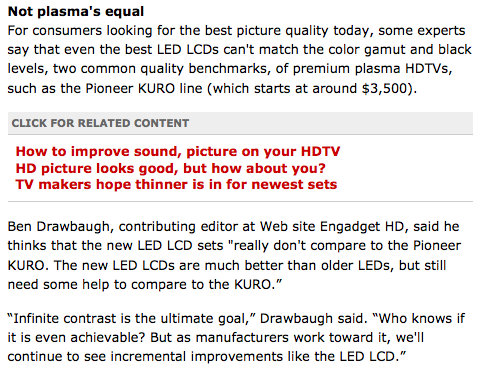
Thanks to my friend Craig Eugea I noticed I was quoted in an MSNBC.com article. You know it really never gets old to see your name in print. It has been some time for me as well. In fact the last one of my quotes to be used — because everyone knows I always have something to say — was back in January of ’08 at the end of the format war. Anyways, I was glad I had a chance to defend plasma’s honor in such a pro-LED LCD TV article and honestly the fact that it was included makes me rethink my opinion of MSNBC in general.

I don’t believe a word that DirecTV says

Friday, December 12th, 2008

If there is one thing I’ve learned about DirecTV over the past three years of blogging is that the PR department has no problem “stretching” the truth in an attempt to improve the image of its company — big surprise, I know. This was never more true then during the DirecTV press conference at CES 2007 where the “100 HD channel” announcement was born. We all know now that this promise was never realized during 2007 and that in some ways it can be argued that it isn’t even true today.

Then there was the entire “HD Lite” fiasco where we at Engdaget got our friend Rômulo Pontual on the record as saying DirecTV had the best quality HD — this was pre-MPEG4 mind you — and that anyone who said different wasn’t actually judging the quality with their own eyes, ha!

So with this in mind it should be no surprise that I don’t believe the recent official suspension announcement about the unofficial HDPC-20 project (also attributed to Romulu). I’m not saying that DirecTV never suspended the project, I’m just saying that it was probably suspended for a half a day while the developers went home early for Thanksgiving. I mean if it was really canceled then why not say canceled? Why say it was suspended with no window of how long. This really just continues the trend of the lack of communication between DirecTV and its customers when it comes to this project.

I predict that there is no real suspension at all, and that in fact the HDPC-20 will be released right along side Windows 7 during 2009, an that the only reason for this “official” communication is to reduce the expectations of the community after the recent eHome labs tour debacle. I believe this is nothing more than damage control from that incident, and a very poor attempt at that.

I finally passed Kevin Tofel!

Wednesday, October 8th, 2008

It only took me two years and nine months, but today I finally passed Kevin C Tofel’s post count (1073) on Engadget HD. Sure, it took me almost three years to do something he managed in nine months, but hey, I actually want to keep my full time job! This makes me the number four poster of all time on Engadget HD, with about four months to go — at this pace — to pass Matt Burns. Honestly I’ll probably never pass Richard and you could add my posts to Richard’s and I still wouldn’t match Darren’s.

My fav EHD comments 2: “Blu-ray is DVD”

Monday, March 3rd, 2008

In the second edition of my fav EHD comments we have a really smart guy who decides to correct me.

Here’s Andy Sullivan in response to my Why Blu-ray will be the next DVD post.

First of all, blu-ray is not competing with DVD. Blu-ray is DVD. It is competing with SD DVD. And unless it can come very close in price for players and movies then too many consumers won’t even pay attention to it.

I really hope you’re joking Andy, as the two aren’t anywhere near the same thing. I’ll give you that they both contain movies and are the same size, but that’s pretty much were the similarities end.

We do agree on the price part, though.

The HD industry is just getting started

Friday, February 22nd, 2008

Now that the format war is over, I’ve had a few people ask or make suggestions about the future of Engadget HD. I’m not sure if they were just making fun or if they really think our site was only about the format war. Sure, we covered the format war a lot, but it was never our identity — but HD movies is a big part of it. All the writers of Engadget HD do it because we love it and while the format war was fun, it was never the reason we got into HD.

Chris Tribbey was working on a piece that was published in this weeks Home Media Magazine and asked me this very question and although he chose to quote me in his most recent article about the format war, he didn’t use the one I think sums up our future, “Sure, eventually when everyone has a HDTV, the digital transition is over, and every channel is available in HD to the point that SD is like black and white, then we’ll run into concerns.” I think as more and more people buy HDTVs and go looking for content and technical information they’ll find Engadget HD and our readership will continue to see the fantastic growth it’s seen over the past few years.

I was glad to see that Tyler from Format War Central was quoted as well and while I do think his site may have reason to be concerned, Tyler is very familiar with the format war. In fact, he is one of my greatest resources on the subject and there aren’t any technical format war posts on Engadget HD that he didn’t help me with.

One of my favorite things about Engadget

Wednesday, December 12th, 2007

I got into this entire business ’cause I like to talk. I started doing a podcast about HD and this lead me to Engadget. My big mouth has gotten me into trouble more than a few times and on a recent EHD Podcast I couldn’t shut up about how much I dislike WealthTV — seriously, have you watched this channel, it’s a perfect example of wasted bandwidth. Needless to say, they didn’t like what I had to say, but who’d a thought they would actually issue a press release accusing me — and Engadget — of being involved in a large corporate conspiracy. First off, we don’t take editorial direction from anyone but Ryan and Peter, and Time Warner is such a large company even if we did, they wouldn’t have any pull. But, no one can explain the situation better than our fearless leader Ryan. His post on the matter on EHD is one of my favorite. I read it a few times and laughed my a’ off every time. So, for a good laugh head over and see how we deal with unfounded accusations.